

Principles of Adventure – Wild Camping / Bivouac
Wild camping is one of the great joys of life.
To put down your head in an idyllic place of your choosing is to feel a true sense of freedom and space, whether that is on a mountain summit, beside a quiet lake or running stream, or on a beach. You could be under the protection of a tiny tent or under the stars; either way, it is an elemental experience. For me as a photographer too, I know at that magical time of two hours either side of dawn that I need only to unzip the door to be where the light is happening. There is nothing like wild camping to restore the soul.
I’d lift my head with each sunrise
If I had a simple soul
When I was weary I’d close my eyes
If I had a simple soul
Not too complicated to shiver when I’m cold
I’d make my home where I am bound
If I had a simple soul, simple soul… Eddi Reader / Simple Soul
Is Wild Camping / Bivouac Legal?
By camping I mean bivouac, which is a common distinction used in French. Camping means “to establish a camp over several days”; bivouac means “to pitch a shelter for the hours of darkness and to move on”.
Legally, in England and Wales, you must have the permission of a landowner to camp on their land. However, there is a tradition of bivouac in hill country and a common understanding that it is tolerated provided that that responsibilities of privilege are observed – leave no trace, cause no nuisance. The Lake District National Park has ackowledged this: “Wild camping on unenclosed fell land, remote from the roads, is generally accepted if undertaken responsibly by small numbers of people“, and under enlightened access laws in Scotland, bivouac is a common right.
It is understandable to have controls, and I have never experienced any difficulty. In our early days of backpacking we would frequently seek permission from farmers to pitch in the corner of a field, and were hardly ever refused.
But I wonder if times are changing. Are people more protective of their privacy and suspicious of anyone breaking the norm? Are backpackers viewed as untidy hirsute vagrants who will march over people’s land lighting fires and causing destruction and noise? Is any kind of sleeping rough socially unacceptable?
Worse; the abhorrent practice of fly-camping, where people camp irresponsibly, light fires and leave their crap and litter, is lumped together under the same “wild-camping” definition. So we responsible bivouacers are tarred with the same filthy brush. It is not fair and the language has to change!
Choosing a Bivouac Spot
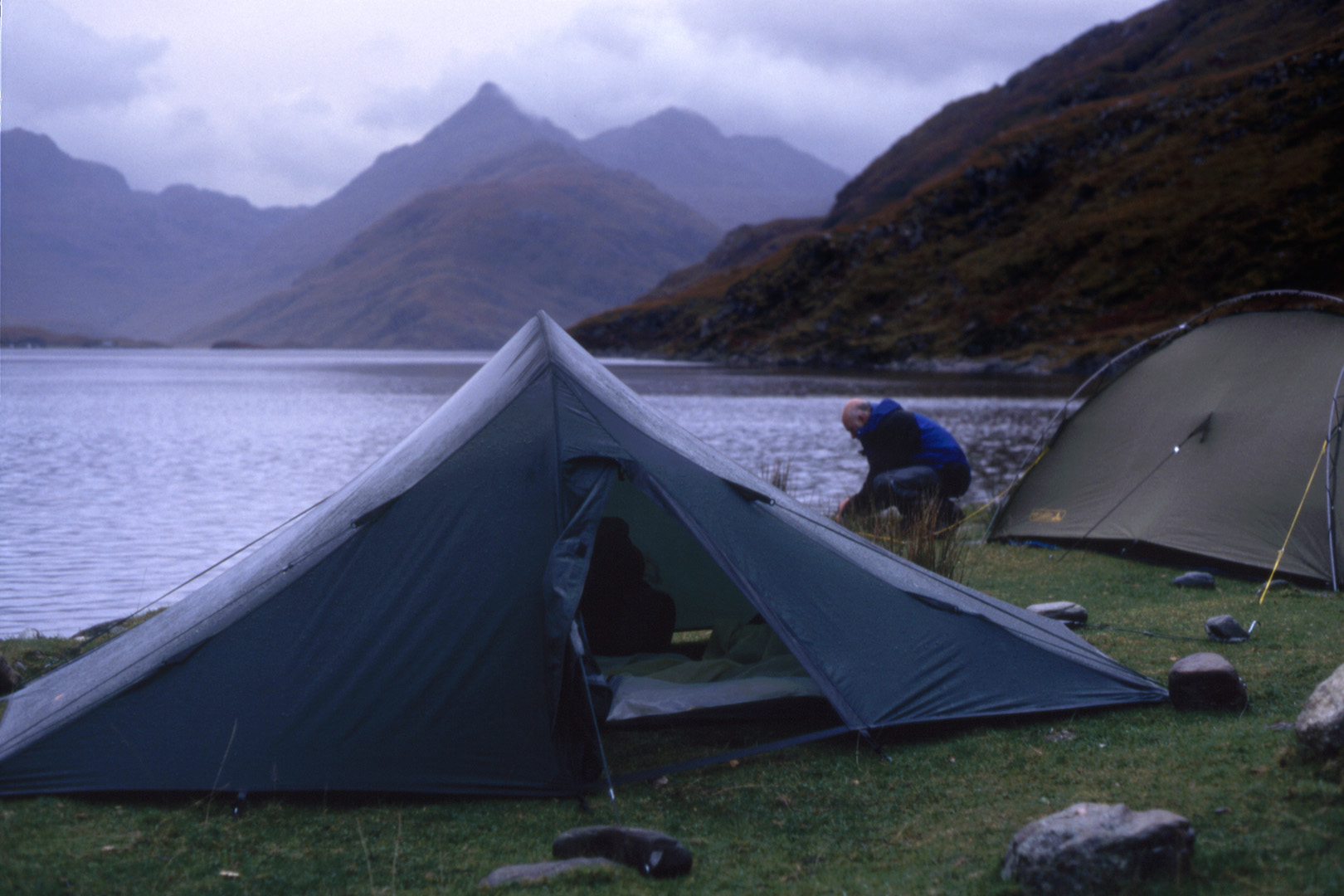
Bivouac beside Loch Nevis
Choosing a spot for wild bivouac is a skill in itself. The place should be flat and grassy as an ideal, with shelter from wind. Ground that lies slightly higher tends not to flood, whereas pitch in a slight hollow and you’ll be flooded in the rain. You should test the ground with your feet, getting a feel for wetness and the depth of soil for good anchors – we all know about the “eternal rock”, which sits an inch below the ground in the very spot where the most important tent peg has to go.
The best places are always grassy flats beside lakes or on the inside of bends in mountain streams. I’ve developed a sense for spotting their greenness from way above. Often there is a sheepfold that provides a windbreak. And of course there is running water. Sparse woods provide good cover too, although they are often dripping wet ong after the rain eases off.
It isn’t always easy, especially to be inconspicuous. Adventurers such as Alastair Humphreys take from time to time to sleeping in culverts under bridges. Comfortable it might not be, but hey; it’s just for one night, right …
Coming Back to Life
It is quite possible to bivouac for an extended period, but there’s no doubt that a little comfort is welcome after a few days, if only to shower properly, to wash clothes and, importantly, to charge gadgets.
So I will use campsites on my Coast17 challenge, and occasionally hostels and bunkhouses too, but only if they offer a backpacker rate of between £5 and £10.
So many campsites don’t get the backpacker ethic. Why should I pay a standard pitch rate that includes a car and an extra adult and maybe 2.4 kids and a dog when all I need arriving on foot is a patch of grass, a water tap and a shower? I take up hardly any room. Oh, and I will probably need to charge a phone. And don’t get me started on industrial-scale caravan cities with entertainment and fun for all the family. Rest assured I shall avoid them if at all possible, assuming that they take tents at all!
Camping in its most traditional form became family camping, then glamping, then lodging in wooden cabins, then … Basically it is an industry. That is not its essence. So wild camping for me is the only way. I shall do it wherever possible and with the utmost respect.
… Ken
4th February 2017


Fantastic Ruari, thanks. Places like this are worth their weight in gold to backpackers. I really appreciate it and will definitely contribute to the local micro-economy. Cheers.
Then for your cost criteria, you will be fine at the North Inn, Pendeen, Cornwall, where John, the landlord, only charges £5 per person per night, including use of the showers which, with the toilets, are situated in the pub itself. You’d have money left over for a pie and a pint!